
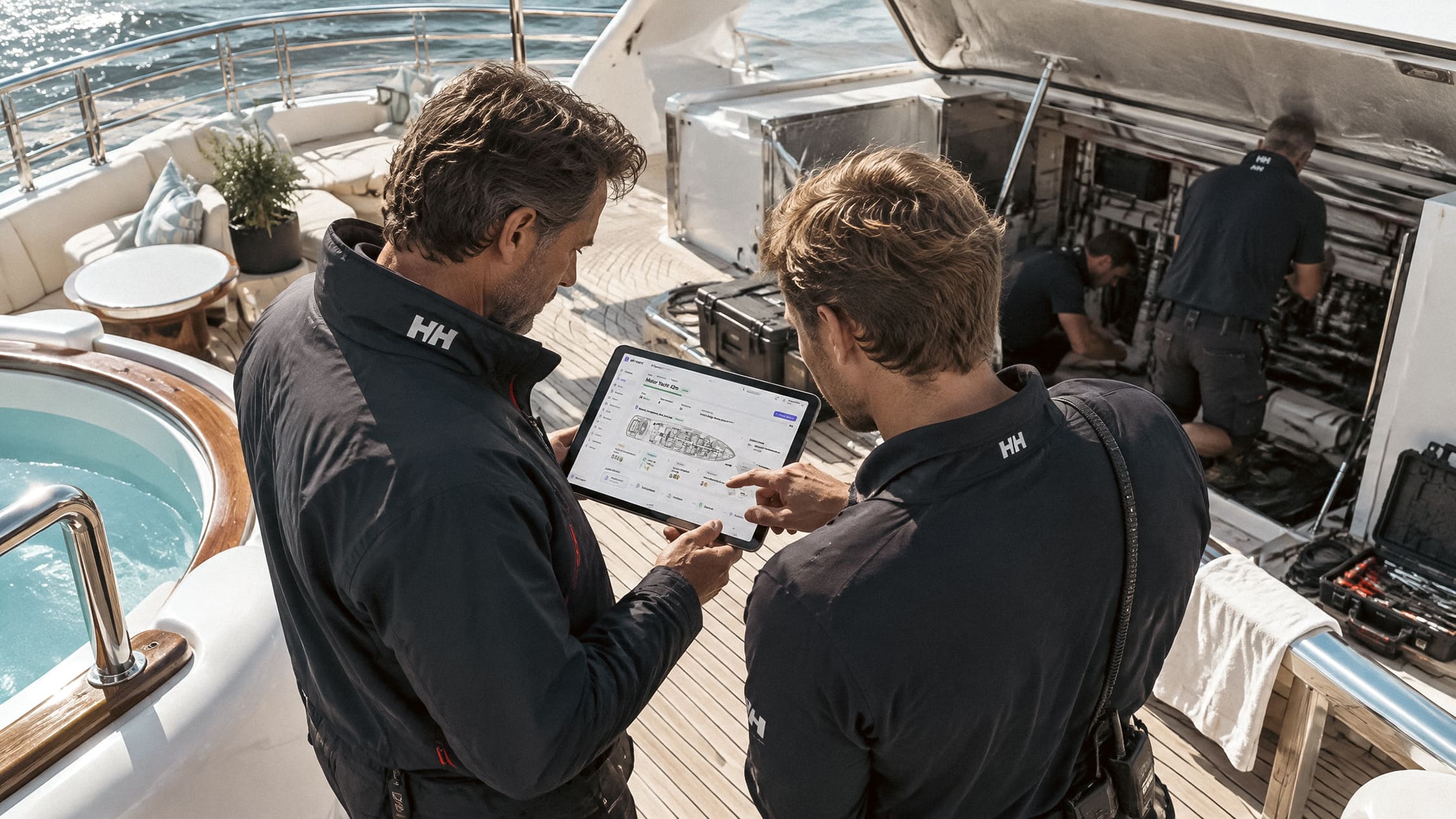
Yacht operations do not need another software tool. They need a connected operating system.
AIOS FOR YACHT OPERATIONS
Yacht operations do not need another software tool. They need a connected operating system.
Why the biggest operational problem in yachting is often not the software itself, but the loss of context between opportunity, quotation, project delivery, procurement, change control and financial reporting.
THE SOFTWARE PARADOX
Yachting businesses are already digital. The operation is often still connected manually.
A modern yacht builder, refit yard, management company or technical service business rarely suffers from a lack of software. There may already be a CRM, a project platform, accounting software, spreadsheets for estimating, shared folders for drawings, procurement tools, email, WhatsApp and specialist applications.
Each tool may work perfectly well on its own. The operational problem appears between them. A client request arrives in one place, an estimate is built somewhere else, the quotation becomes a PDF, the delivery team receives a handover, suppliers follow another process and management waits for somebody to assemble the latest position.
The business is using software, but people are still acting as the integration layer.
That is where time disappears. More importantly, that is where context disappears.
The expensive part is not the number of tools. It is the handoff between them.
Consider a typical sequence. An enquiry arrives by email. The commercial team creates an opportunity and starts collecting drawings, specifications, photographs and notes. An estimator builds the internal cost. A client quotation is prepared and revised. The work is awarded. The project team then creates the live job, procurement starts raising supplier requests, site teams begin reporting progress and issues, changes happen on board, and finance eventually needs to understand the commercial position.
Every arrow in that sequence is a potential break in continuity.
ENQUIRY → ESTIMATE → QUOTATION → CONTRACT → PROJECT → PROCUREMENT → CHANGE → CLOSEOUT
The problem is not that different teams are involved. They should be. The problem is that each stage often creates a new version of the truth.
The commercial team knows what the client originally asked for. The estimator knows how the price was built. The project manager knows what is actually happening. Procurement knows what has been ordered. Finance knows what has been invoiced. But the business does not always have one connected history explaining how those facts relate to each other.
Winning the job should create a baseline, not a blank project.
One of the most important handoffs happens after commercial acceptance. The business has already spent time understanding the requirement, building the estimate, structuring the price, defining assumptions and exclusions, revising the quotation and agreeing dates.
Then the job is won, a new Project is created and the delivery team is often asked to start again.
A connected workflow does the opposite. The accepted commercial state becomes the original Project baseline: accepted quotation revision, contract value, estimated cost, expected margin, dates, scope, drawings, material quantities, assumptions, exclusions and relevant documents.
Internal costing and client pricing also remain related without becoming the same thing. A client might see one commercial line called Main Deck Interior Works. Internally, that line may contain labour hours, rate cards, materials, specialist subcontractors, supplier quotations, logistics, contingency and margin. Both views matter. They simply serve different purposes.
Preserving both views means the project team understands what was sold, while management can still see the commercial logic underneath it.
Projects change. The system should not rewrite history with them.
Yacht projects evolve. A client requests an addition. Something is omitted. A design changes. A technical condition requires a different solution. A supplier constraint affects the programme. None of this is unusual.
The control problem begins when the operational change, client approval, variation, schedule impact and financial effect are tracked in different places.
The useful distinction is simple:
ORIGINAL → CURRENT → FINAL
The original position is what was sold and accepted. The current position is the original baseline plus the approved changes that have happened since. The final position is what was actually delivered and financially closed.
The system should allow the Project to change without allowing the history to change with it.
That makes it possible to explain how scope, contract value, cost, dates and margin moved over time. It also means a variation is not just another PDF. It is a controlled change to the current project position, linked back to the reason the change happened.
On a yacht, context is often physical as well as digital.
Many yacht issues are inherently spatial. They happen in a cabin, on a deck, behind a panel or inside a technical space. Describing the same location repeatedly through screenshots and messages introduces ambiguity.
A structured annotation on a GA or technical drawing can exist before the Project is created, while the opportunity is still being understood. Later, that same location can remain connected to a quotation item, task, incident, photograph, approval or Change Request.
The location stays constant while the business meaning around it evolves. This is a small example of a broader principle: useful operational context should survive the lifecycle instead of being recreated at every stage.
The same principle applies to procurement, subcontractors and client collaboration.
A material requirement should begin with the Project need, not with somebody retyping it into a purchasing sheet. A subcontractor Work Order should remain connected to the scope and evidence behind it. A client approval should become part of the Project record instead of disappearing inside an email thread.
Different users can still work through different views and permissions. The point is not to make everybody use the same screen. The point is to make sure their actions update the same underlying operational context.
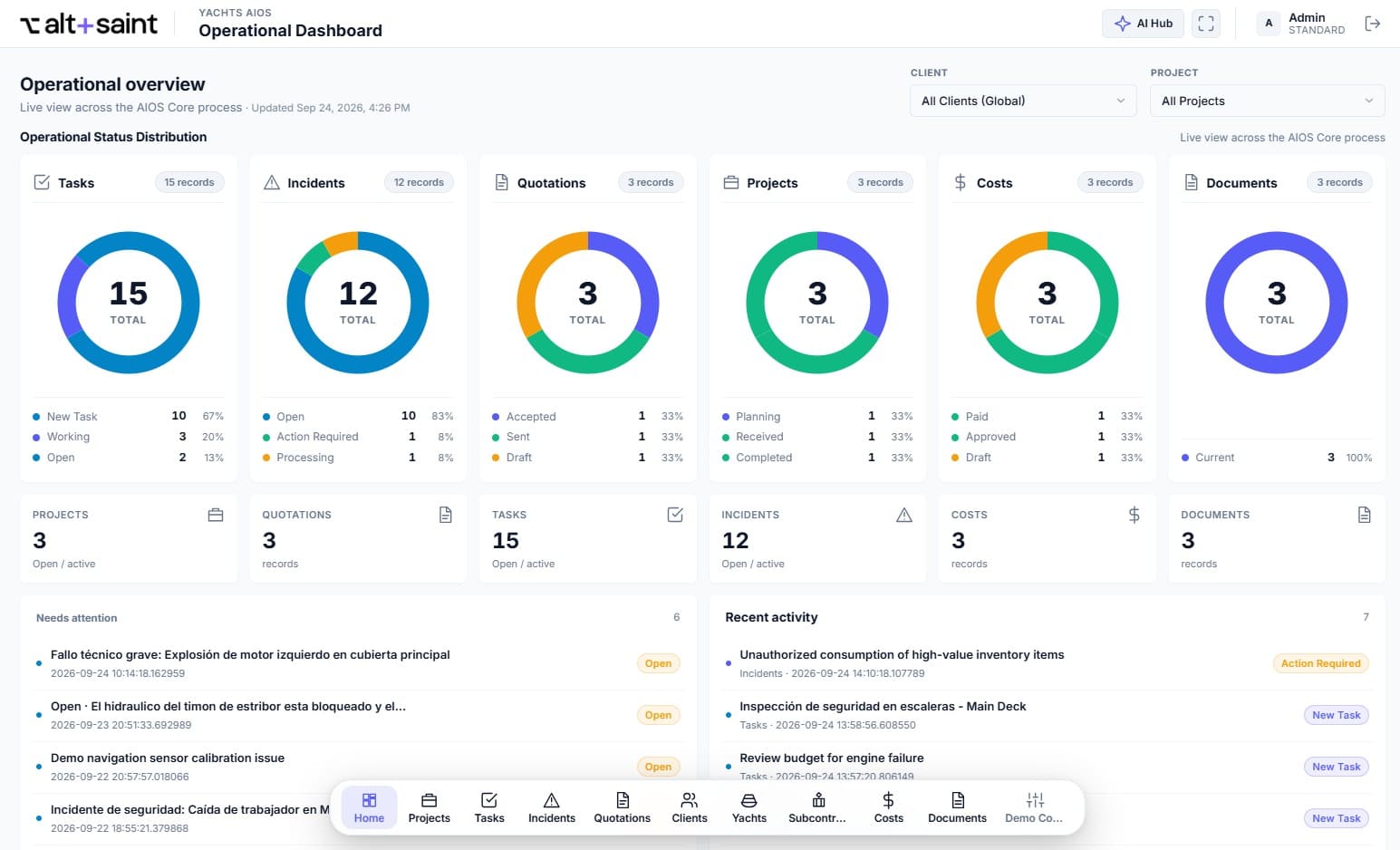
AI is not the operating system. It becomes useful because the operation has context.
AI is often presented as the solution to fragmented operations. It is not. If the underlying business context is fragmented, AI simply inherits a fragmented view of the business.
It becomes more interesting once Opportunities, quotations, contracts, Projects, materials, suppliers, changes, financials, documents and approvals already share context.
An authorised user can then ask questions such as: Which milestones are at risk? Which client approvals are still outstanding? Which materials could delay the next phase? Which approved changes affected contract value? What changed on this Project this week?
AI can also assist behind the interface by reading incoming documents and emails, classifying information, comparing revisions, summarising supplier quotations, identifying missing actions and routing information into the correct workflow.
The objective is not to remove human accountability. It is to reduce the effort required to find, connect and interpret information before a decision is made.
The real shift is from software tools to operational continuity.
A connected operating system does not require a business to replace every specialist tool. Accounting software can remain the accounting system. CAD and design platforms remain specialist tools. Email and messaging will continue to exist.
The more important question is where the operating truth lives.
Can the business move from the first client request to final project margin without repeatedly losing and rebuilding context? Can the project team see what was sold, what changed and what is currently approved? Can procurement trace a purchase back to the Project requirement that created it? Can management understand where margin is heading before closeout? Can AI answer questions from connected operational context rather than isolated documents?
If the answer is yes, the company is no longer simply using a collection of software tools. It has started to build an operating system around the way the business actually works.
ALT SAINT AIOS FOR YACHT OPERATIONS
One yacht. One connected operational history. From opportunity to final margin.
ALT SAINT AIOS applies this connected model to yacht operations, linking the commercial, project, procurement, collaboration, financial, document and AI-assisted workflows behind each yacht.