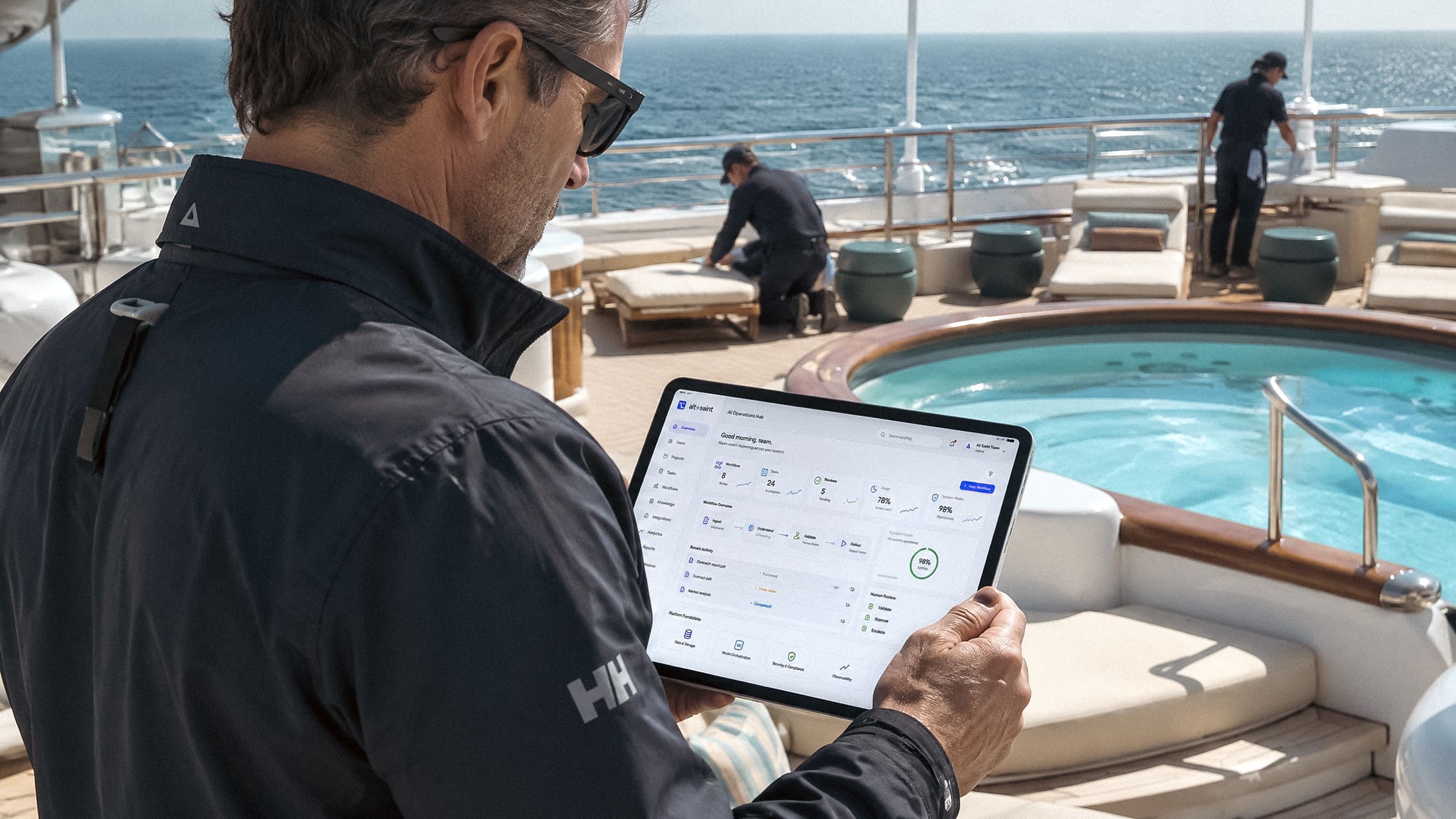
AIOS for Yacht Operations
ALT SAINT AIOS FOR YACHT OPERATIONS
One operating system for the business behind every yacht.
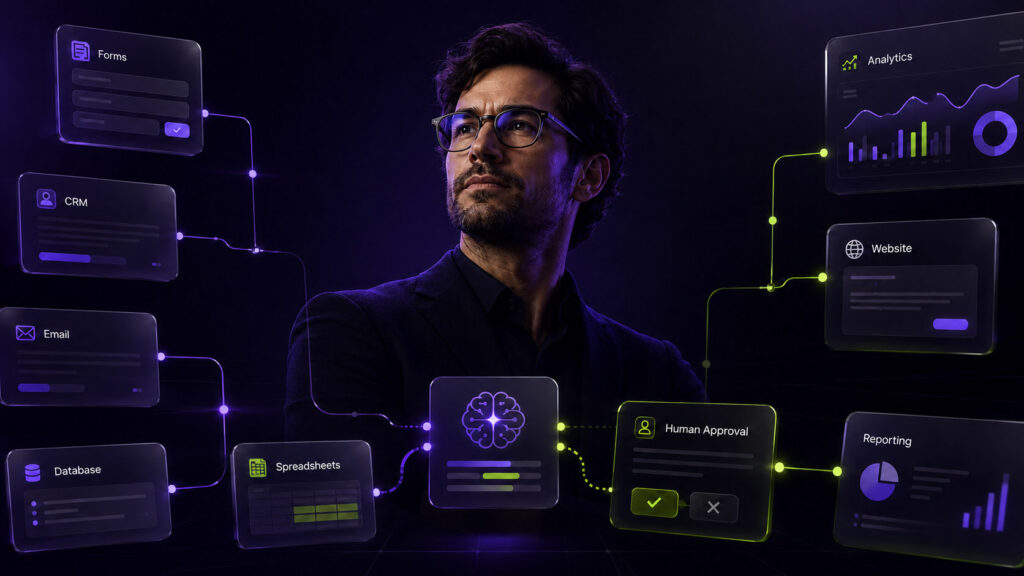
Connect the full commercial and operational lifecycle behind each yacht, from opportunity, estimating and quotation to contract, project planning, field execution, materials, procurement, subcontractors, variations, financial control, closeout and reporting, in one connected operating environment with built-in AI.
BUILT FOR YACHT OPERATIONS
Yacht Builders · Refit & Repair Yards · Yacht Management · Brokerage · Service Companies · Marine Suppliers
THE OPERATIONAL PROBLEM IN YACHTING
The problem is not a lack of software. It is the gaps between the systems.
Yachting businesses already use CRM platforms, spreadsheets, accounting software, project tools, shared folders, email, WhatsApp, supplier files and specialist systems. Each tool may do its own job well, while the operation still depends on people manually moving information from one system, team and project stage to the next.
Those gaps appear at the most important handoffs: enquiry to estimate, quotation to contract, contract to project, project requirement to procurement, site issue to action, change to variation, and operational cost to management reporting.
AIOS is designed to make those handoffs continuous. Client, yacht, opportunity, commercial, project, field, supplier, material, financial and document information stays connected as work moves through the business, while specialist systems can remain integrated where they still create value.
WHERE YACHT OPERATIONS LOSE CONTROL
The hidden cost of broken operational continuity.
The cost of fragmentation is not only time. It affects handovers, approvals, procurement, client communication, project margin and the ability to scale without adding equivalent administrative overhead.
Fragmented commercial and project data
Briefs, drawings, estimates, quotation revisions, contracts and project information sit in different tools, forcing teams to rebuild context at every handoff.
Repeated data entry and administration
Client, yacht, material, supplier and project information is copied between CRM records, spreadsheets, emails, documents and project systems.
Commercial handover gaps
What was sold, costed, assumed and excluded can become detached from the project once delivery begins.
Slow approvals and procurement
Drawings, materials, variations, supplier decisions and client approvals wait in inboxes or chats instead of moving through a controlled workflow.
Margin becomes difficult to see
Original estimate, committed cost, actual cost, variations, invoicing and payment data are often separated, making current project margin difficult to understand.
Clients and subcontractors work around the system
External collaboration happens through PDFs, email and messaging, creating duplicate updates and limited visibility for the internal team.
ONE CONNECTED OPERATING LAYER
From first enquiry to final margin, keep every yacht, decision and workflow connected.
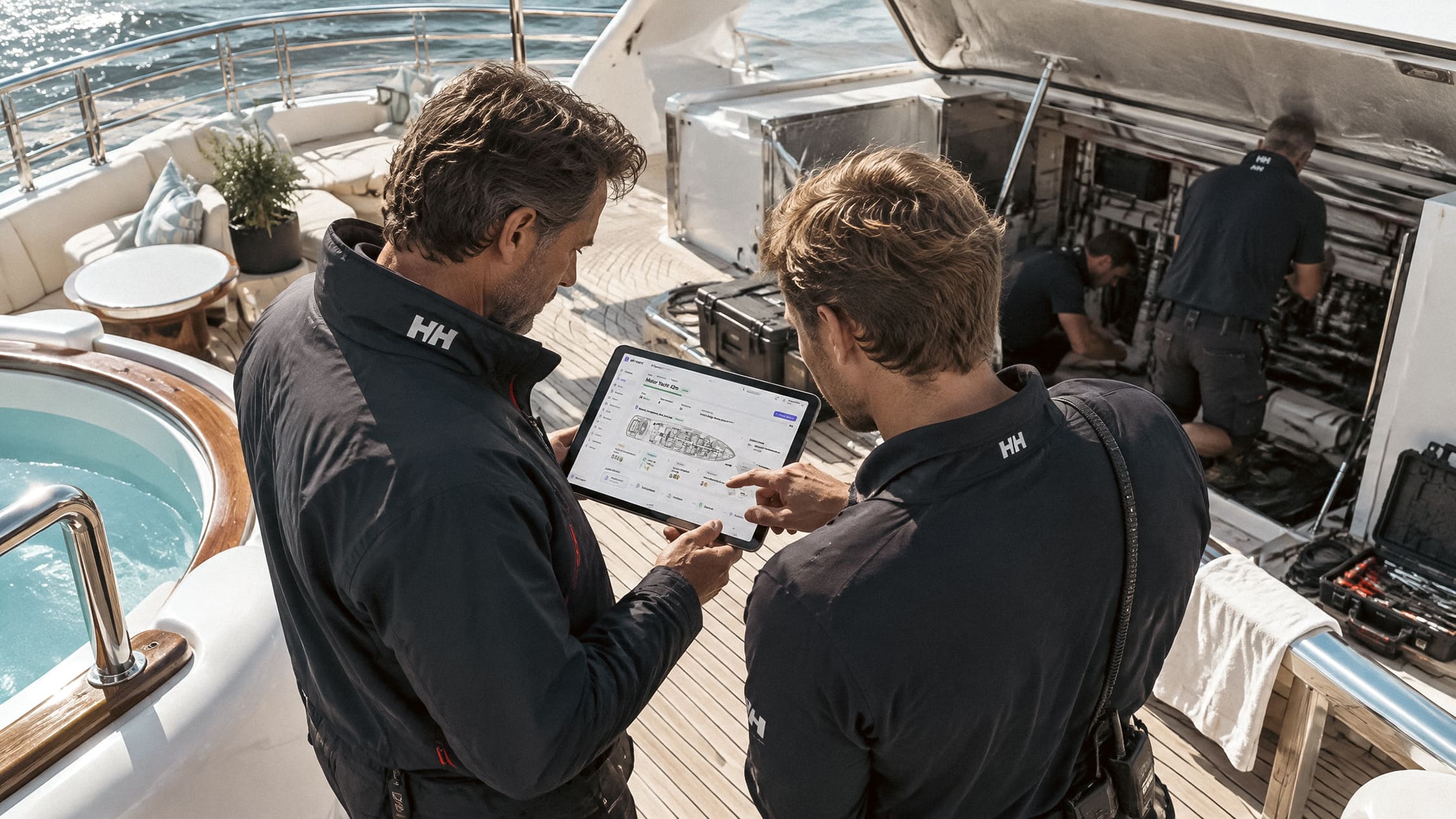
AIOS connects opportunity management, estimating, quotation, contract, project planning, execution, materials, procurement, subcontractors, approvals, changes, financial control, portals, documents and AI around the same underlying business objects. Information stays connected as the job moves from commercial intent to operational delivery and closeout.
AIOS YACHT
One operating system for the complete yacht project lifecycle.
AIOS combines commercial, project, field, procurement, collaboration, financial and AI capabilities in one connected operating model. Each module shares context with the others, so information does not restart every time the job moves to a new stage or team.
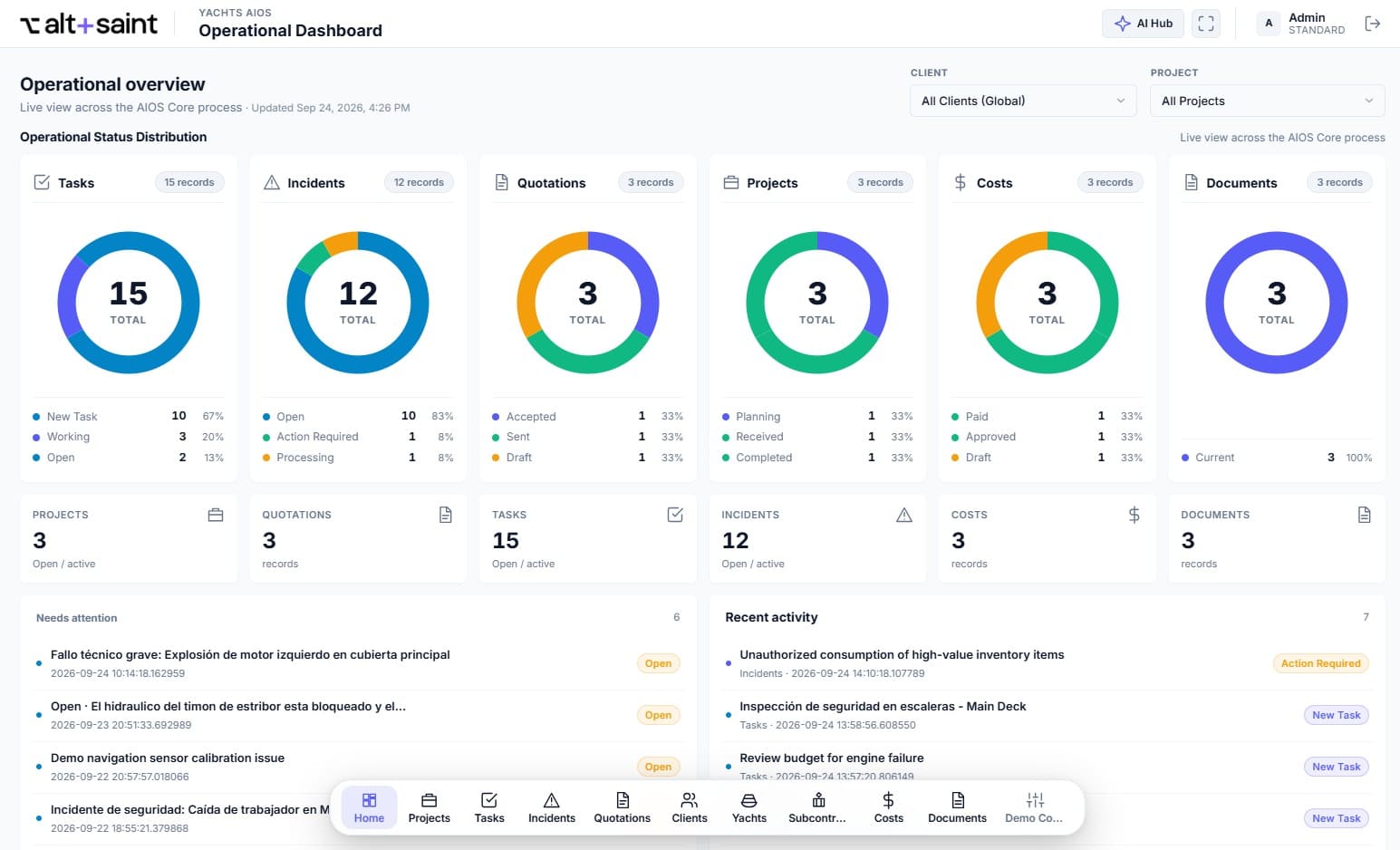
Operational Dashboard
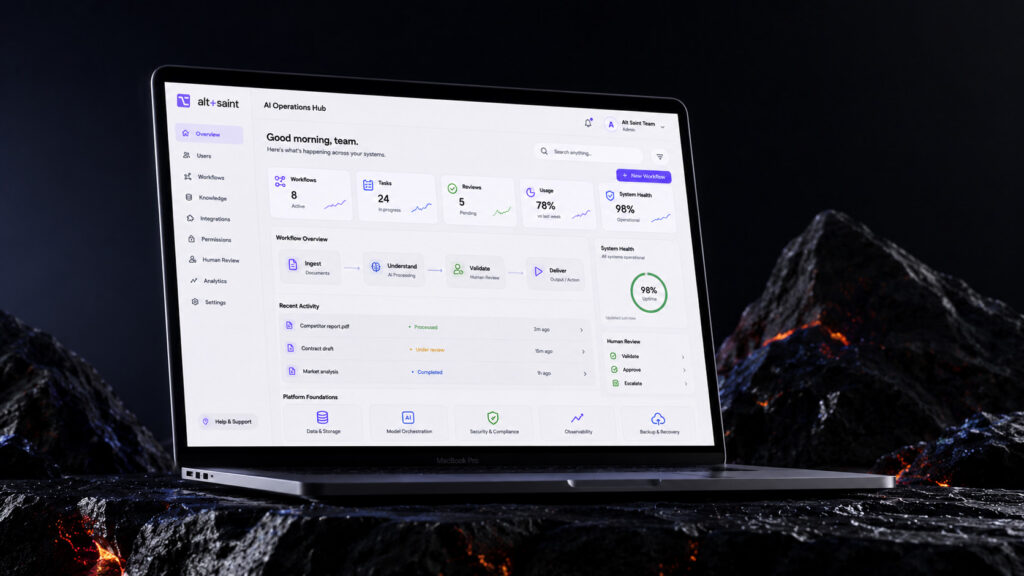
A live overview of opportunities, projects, tasks, approvals, issues, procurement, financial status and what requires attention.
Clients, Yachts & Opportunities
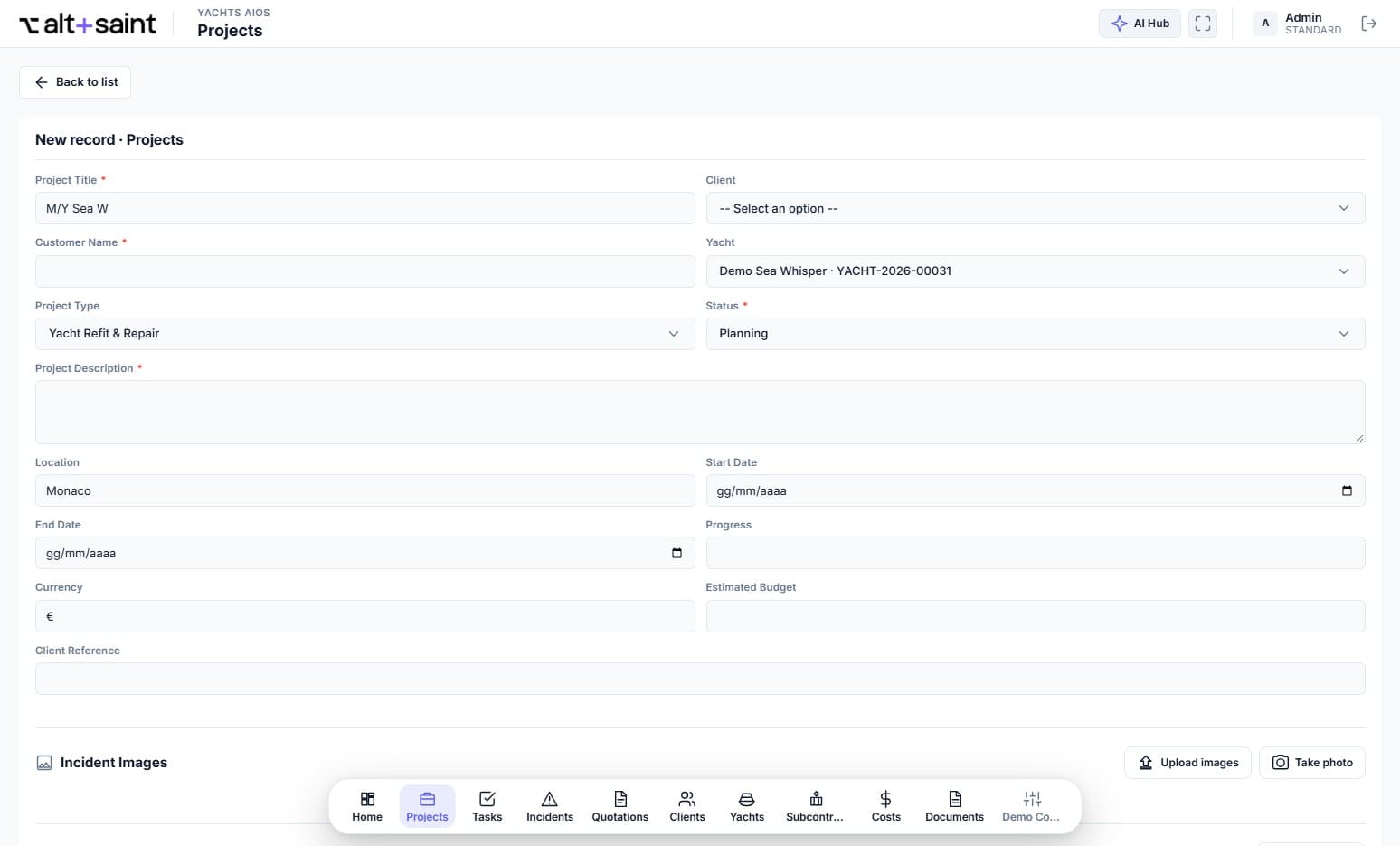
Connect client and yacht context to a pre-project Opportunity Workspace holding the brief, contacts, dates, documents, drawings, notes and next actions.
Estimating & Internal Costing
Build internal cost from labour, materials, suppliers and subcontractors while preserving the commercial logic behind the client price.
Quotations & Revisions
Create client, variation and subcontractor quotations with revisions, commercial grouping, margin control and a complete history of what was offered.
Contracts & Commercial Baseline
Turn accepted commercial data into a contract with value, dates, payment schedule, contractual milestones, signed documents and client references.
Project Planning
Manage phases, work packages, deliverables and milestones with planned versus actual dates, dependencies, progress and approval gates.
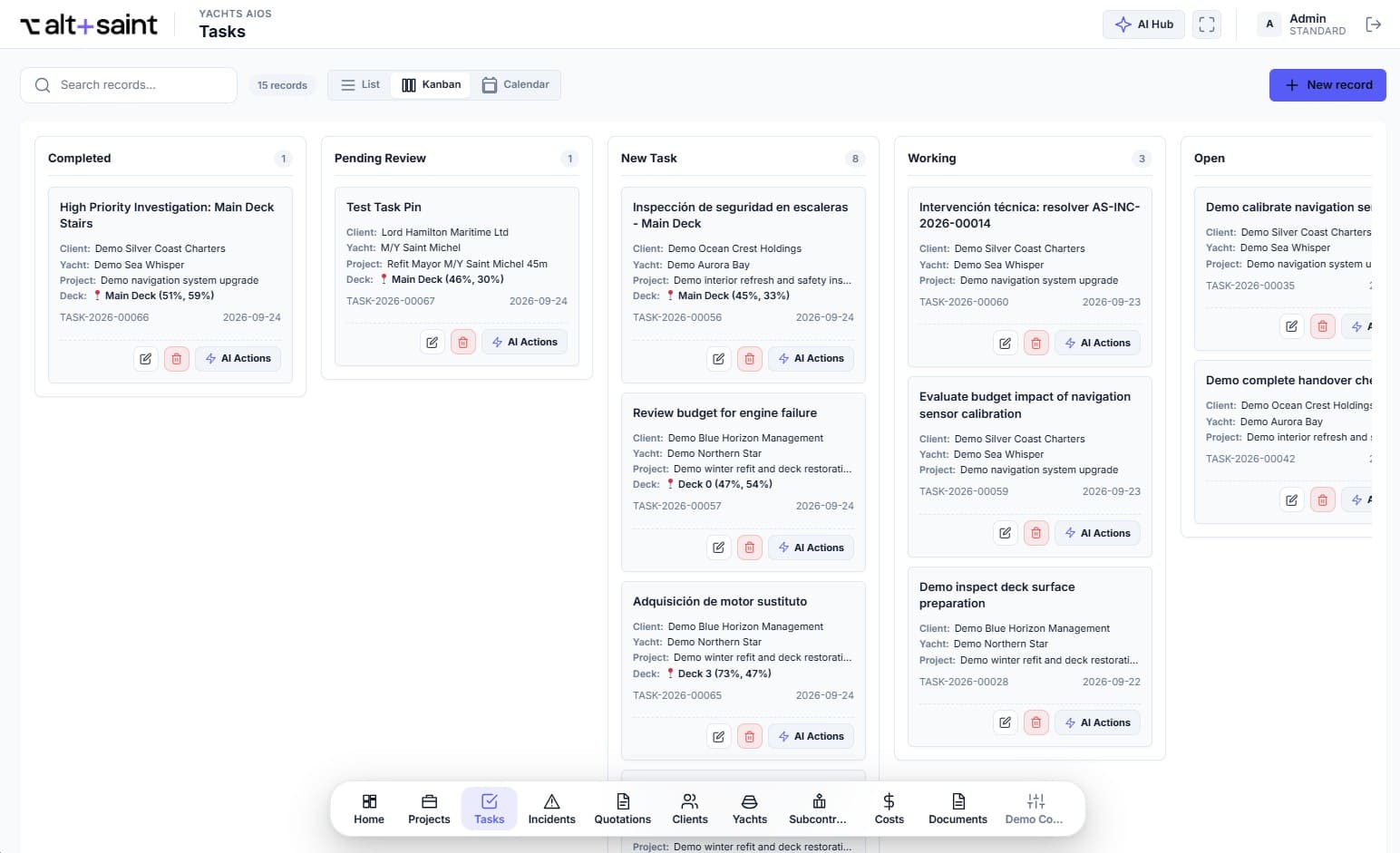
Tasks, Work Orders & Work Logs
Assign operational actions, connect subcontractor work, record progress and capture approved work logs without losing project context.
Issues, Incidents & Approvals
Track technical, quality, safety and operational issues and route drawing, material, milestone, variation and completion approvals through controlled workflows.
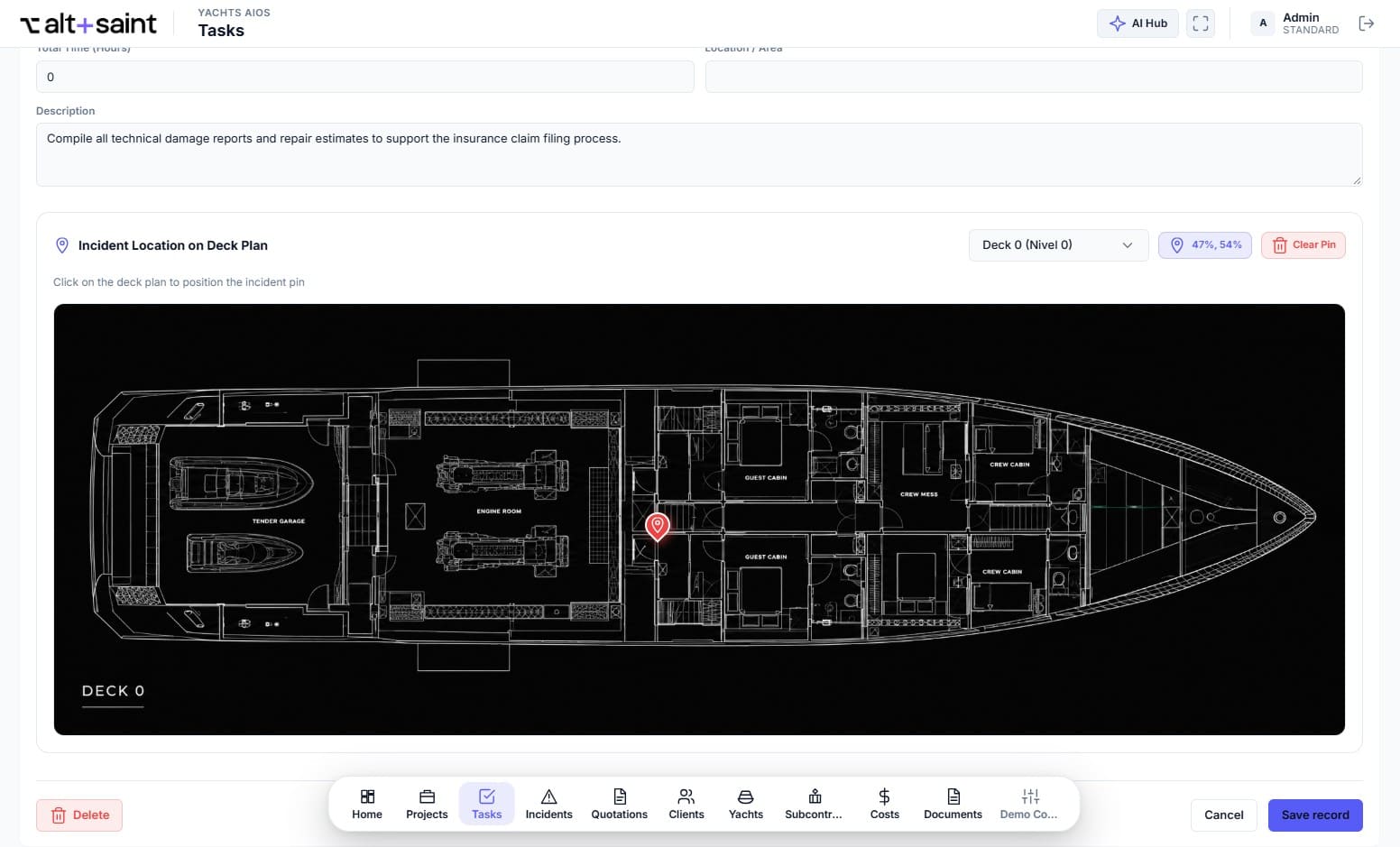
GA Plans & Spatial Annotations
Use yacht drawings as live operational interfaces. An annotation can link estimating, quotation items, tasks, incidents, changes, photos and evidence to the same physical location.
Documents & Drawings
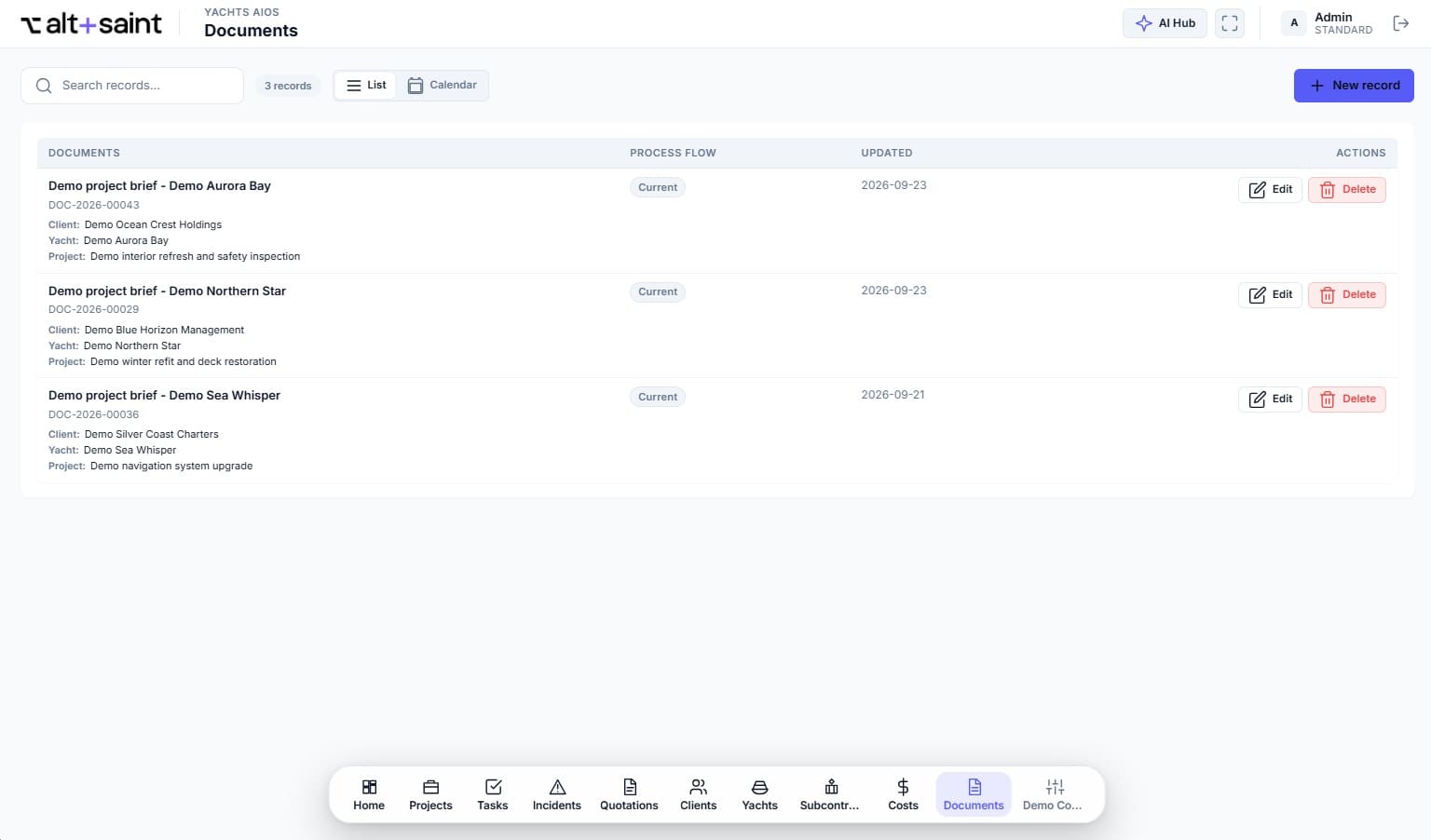
Keep briefs, specifications, drawings, reports, photos, certificates, contracts and evidence linked to the records and decisions they support.
Materials, Stock & Barcode
Carry estimated material requirements into the live project, check stock, reserve and pick available items, receive missing material and allocate consumption to the project.
Procurement
Move from project requirement to RFQ, supplier quotation, purchase order, receipt and project cost without rebuilding the requirement in another system.
Suppliers & Subcontractors
Manage RFQs, quotations, Work Orders, deadlines, documents, progress, evidence and payment context around the same project workflow.
Client Portal
Give clients controlled access to progress, milestones, approved variations, shared documents, approvals, selected financial information and closeout records.
Subcontractor Portal
Let subcontractors respond to RFQs, access Work Orders and drawings, update progress, submit Work Logs and evidence, report issues and request completion approval.
Change & Variation Control
Record additions, omissions, technical or design changes, cost and schedule impact, approval status and variation quotations without overwriting the original baseline.
Financial Control & Margin
Track original and current contract value, estimated, committed and actual cost, invoiced, paid, outstanding and project margin through to closeout.
AI Assistant & Automation
Ask questions across authorised operational data while AI reads, classifies, summarises, cross-checks and routes information across connected workflows.
ONE CORE. ADAPTED TO YACHT OPERATIONS.
A flexible operating system for different yachting businesses and workflows.
The same modular foundation can support yacht builders, refit yards, yacht management companies, brokers, service providers, technical specialists and marine suppliers, each with different operational priorities.
Each implementation can use the terminology, yacht records, roles, permissions, approval rules and operational logic of the business. Existing systems can be connected where appropriate, and company-specific modules can be developed as part of a scoped implementation when the standard core does not cover a required workflow.
ONE SYSTEM, DIFFERENT WORKING VIEWS
The same operation, presented to each person in the way they need to use it.
AIOS is role-based. Internal teams, management, clients and subcontractors work from the same underlying project information with different permissions, actions and views.
CEO & Shareholder View
Portfolio-level visibility across opportunities, projects, margin, cash position, risks, delays, approvals and management KPIs.
Commercial & Estimating Teams
Opportunity, basis documents, internal costing, quotation revisions, contract preparation and commercial history in one workspace.
Project & Office Teams
Project plans, tasks, milestones, documents, procurement, subcontractors, changes, financial status and approvals from desktop or tablet.
Yard & Field Teams
Mobile access to assigned tasks, issues, photos, documents, plan annotations and work evidence where the work actually happens.
Client View
Controlled portal access to the project information, approvals, milestones, reports and documents selected for the client.
Subcontractor View
Controlled access to RFQs, Work Orders, scope, deadlines, drawings, progress updates, Work Logs, evidence and completion requests.
GA & TECHNICAL PLAN ANNOTATIONS
Turn a yacht drawing into a persistent operational interface.
Upload a GA, deck plan, room layout or technical drawing and place structured annotations directly on the plan. The location can exist before the Project is created and remain connected throughout the lifecycle.
The same annotation can support an estimating note, quotation item, task, incident, change request, photo, document or approval. Instead of repeatedly describing the physical location through screenshots and messages, AIOS keeps the location, ownership, evidence, status and history connected.
This creates continuity between what was identified during opportunity and estimating, what was sold, and what is later executed or changed on board.
CLIENT & SUBCONTRACTOR PORTALS
Bring external collaboration inside the same project workflow.
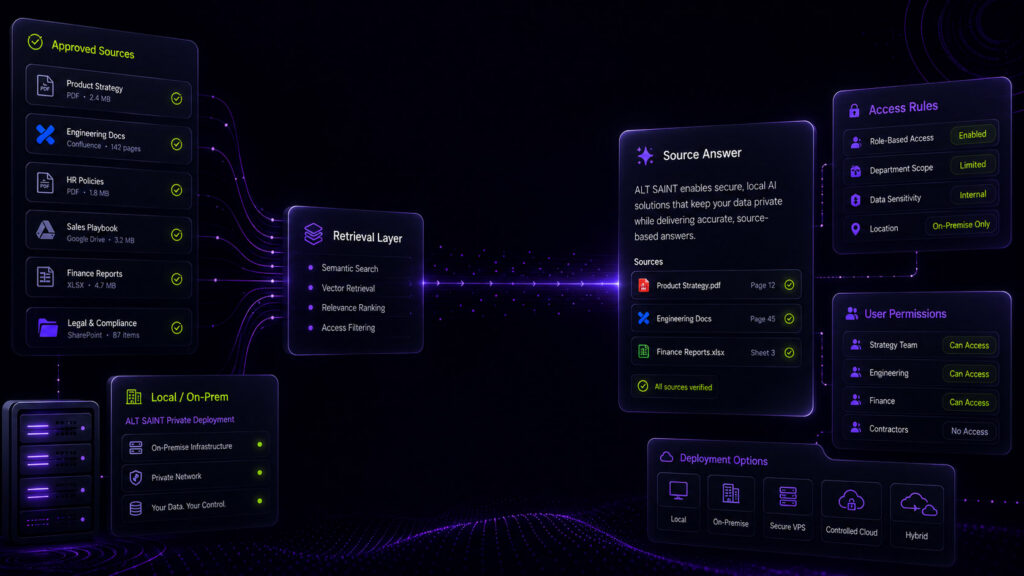
Clients and subcontractors do not need separate databases or parallel processes. AIOS exposes controlled views of the same project objects, with permissions deciding exactly what each external user can see and do.
Client Portal
Share project overview, contractual timeline, milestones, approved variations, drawings, documents, reports, photos, approvals and closeout information without exposing internal cost or private notes.
Subcontractor Portal
Run RFQs, quotation submissions, Work Orders, scope, tasks, progress, Work Logs, evidence, incidents and completion approvals without re-entering subcontractor updates internally.
Controlled Approvals
Capture who approved what, when, with comments and evidence across drawings, materials, milestones, supplier selections, variations, completion and handover.
BUILT-IN AI ASSISTANT
Ask AIOS what is happening across the business, in natural language.
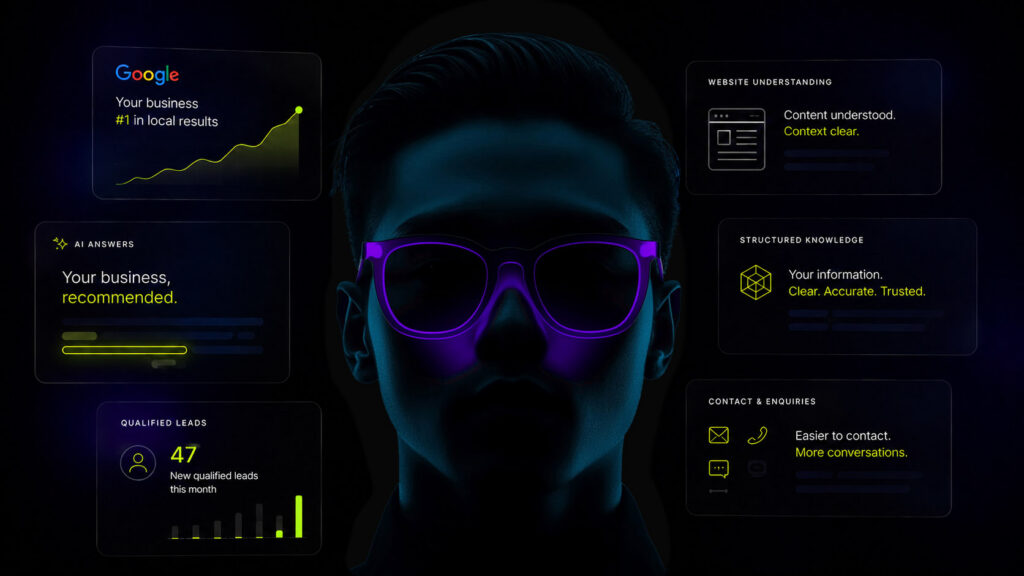
The built-in AI Assistant gives authorised users a conversational way to query the operational information already inside AIOS. Because opportunities, quotations, contracts, projects, materials, suppliers, changes, financials, documents and approvals share context, the Assistant can answer questions across the workflow instead of searching one isolated module at a time.
Examples include: What changed on this project this week? · Which milestones are at risk? · Which client approvals are still outstanding? · Which materials or supplier actions could delay the next phase? · Which approved changes affected contract value? · What is the current forecast margin? · Summarise the project for management.
AI functions can also read, classify and summarise documents and emails, compare information, identify missing actions, route notifications and prepare structured data for the relevant workflow. Technical, financial, safety and client-facing decisions remain controlled through permissions, approvals and accountable users.
ONE LIFECYCLE. ONE SOURCE OF TRUTH.
Connect the yacht project journey from first enquiry to final margin.
AIOS keeps the information, decisions, approvals and financial consequences connected as the job moves from pre-sales through delivery, change control and closeout.
01
Enquiry → Opportunity → Basis
Capture the client request once. Build the commercial workspace around client, yacht, brief, documents, drawings, photos, specifications, notes and spatial annotations.
02
Estimate → Quotation → Revision
Build internal cost from labour, materials, suppliers and subcontractors, apply commercial pricing and manage client quotation revisions without losing the costing logic.
03
Contract → Original Baseline
Turn accepted commercial data into the contract and create the Project with the accepted quotation, original contract value, estimated cost, expected margin, dates, assumptions and documents preserved.
04
Plan → Execute → Approve
Structure phases, work packages, milestones and tasks, then manage actual progress, dependencies, evidence, issues and approval gates through delivery.
05
Materials → Stock → Procurement
Convert estimated material quantities into project requirements, reserve available stock, pick by barcode and purchase missing items through RFQ, PO and receipt.
06
Subcontractor → Work Order → Evidence
Run RFQs and supplier quotations, award Work Orders and let subcontractors update progress, Work Logs, photos, issues and completion evidence through their portal.
07
Change → Variation → Current Position
Record additions, omissions and technical or design changes, assess cost and schedule impact, create a variation quotation where required and update the current commercial position after approval.
08
Financial Control → Closeout → Final Margin
Track baseline, committed and actual cost, contract value, invoicing, payments and margin through closeout while preserving a complete operational and commercial history.
ORIGINAL. CURRENT. FINAL.
Keep the baseline intact while the project evolves.
AIOS separates what was originally sold from the approved current position and the final delivered result. This makes change control and project margin visible without rewriting history.
| Control point | Original | Current / Live | Closeout |
|---|---|---|---|
| Contract value | Accepted contract value | Original value + approved additions – approved omissions | Final contract value |
| Cost | Accepted estimated cost | Committed cost + actual cost + forecast exposure | Final actual cost |
| Scope | Accepted scope and assumptions | Original scope + approved changes | Final delivered scope |
| Schedule | Contractual baseline | Current milestones and approved schedule impact | Actual completion dates |
| Margin | Original expected margin | Current / forecast margin | Final project margin |
HOW WE IMPLEMENT AIOS
From the working AIOS YACHT platform to a system configured around your operation.
AIOS YACH provides the complete commercial-to-operational architecture. Implementation configures that working core around your terminology, roles, approvals, templates, integrations, data and operating rules.
01
Live AIOS Walkthrough & Fit
We walk through the complete AIOS YACHT lifecycle and focus the demonstration on the commercial, project, field, procurement, portal, financial and AI workflows most relevant to your business.
02
Scoped Discovery & Process Mapping
We map your workflows, tools, users, data, documents, handoffs, approval points and operational priorities so AIOS can be configured around the way your operation actually works.
03
AIOS Architecture
We define the configuration, user roles, portal permissions, integrations, automations, AI functions, templates and governance required for your implementation.
04
Configuration, Integrations & Custom Modules
We configure AIOS YACHT, connect relevant existing systems and adapt company-specific workflows, terminology and modules where required.
05
Testing with Real Workflows
We test complete real-life scenarios from opportunity and quotation through project delivery, procurement, external collaboration, variation, financial control and closeout before rollout.
06
Measure, Refine & Expand
We review adoption and results, refine the workflows and extend AIOS into additional yachts, teams, processes or modules where it creates value.
MEASURABLE VALUE FOR YACHT OPERATIONS
The ROI is measured in time recovered, delays avoided and better control delivered.
Before implementation, the relevant operational baseline and success measures can be agreed around the workflows included in scope.
Time recovered
Track hours removed from repeated data entry, commercial handovers, reporting, yacht updates, supplier chasing, approval follow-up and internal coordination.
Fewer errors and less rework
Reduce duplicated data, missed actions, outdated yacht information, document inconsistencies and avoidable rework.
Faster response and approvals
Measure how quickly client enquiries, quotations, supplier decisions, approvals, incidents and project actions move through the business.
Better commercial follow-up
Improve opportunity follow-up, quotation conversion, variation control and visibility of every active commercial commitment.
More yachts and projects per team
Increase the number of yachts, clients, projects and service requests the team can manage without equivalent growth in administrative overhead.
Better operational visibility
Give decision-makers a current view of opportunities, contract value, projects, committed and actual cost, margin, procurement, approvals, variations and open issues without waiting for manual reports.
WHY AIOS FITS YACHT OPERATIONS
Built around the lifecycle of the yacht project, not around the limits of another isolated platform.
AIOS connects the commercial, operational and financial objects that need to move together while allowing specialist systems to remain integrated where appropriate.
| Area | ALT SAINT Yacht AIOS | Fragmented software stack | Operational impact |
|---|---|---|---|
| Operating model | One connected lifecycle from Opportunity to Closeout and Final Margin. | Separate CRM, estimating, project, procurement, collaboration and reporting tools. | Less rebuilding of context between teams and project stages. |
| Commercial continuity | Opportunity, estimate, quotation, contract and project share the same commercial history. | Commercial information is often handed over through PDFs, spreadsheets and meetings. | What was sold, assumed and costed remains visible during delivery. |
| Project management | Phases, work packages, milestones, tasks, dependencies, progress and approvals share the same project context. | Task and project tools often operate separately from commercial, supplier and financial information. | Operational progress can be understood together with its commercial impact. |
| Materials & procurement | Estimated requirements flow into project materials, stock, purchase requirements, RFQs, POs, receipts and project cost. | Materials are repeatedly re-entered into separate stock and purchasing workflows. | Less duplication and clearer requirement-to-cost traceability. |
| External collaboration | Client and Subcontractor Portals expose controlled views of the same AIOS records. | Clients and subcontractors communicate through email, PDFs, messaging and separate portals. | External actions become part of the live project workflow. |
| Change control | Change Requests, variation quotations and approvals update the current position while preserving the original baseline. | Changes are often tracked across emails, spreadsheets and revised documents. | Original, current and final scope, value, cost and margin remain distinguishable. |
| Financial control | Contract value, committed cost, actual cost, invoiced, paid, outstanding and margin are visible by Project. | Financial information is split between estimating, accounting and project reporting. | Management can see where the project is heading before closeout. |
| AI | AI works across authorised commercial, project, procurement, financial and document context. | AI is typically isolated from the operational data model. | Answers and automations can use the same connected business context as the team. |
AIOS YACHT. CONFIGURED FOR YACHT OPERATIONS.
Start from a complete operating architecture, not from a blank software project.
ALT SAINT Yacht AIOS YACHT connects opportunity management, estimating, quotations, contracts, project planning, tasks, incidents, approvals, materials, stock, procurement, suppliers, subcontractors, client and subcontractor portals, changes, financial control, documents, dashboards and AI-assisted operations.
Each deployment configures that complete core around the client’s terminology, workflows, roles, permissions, templates, integrations and operating rules. This provides a faster and more controlled starting point than assembling or developing a fragmented stack from zero.
SEE THE WORKING YACHT AIOS
See the complete yacht project lifecycle inside one system.
On the first call we can walk through AIOS YACHT from Opportunity, estimating and quotation through Contract, Project, materials, procurement, subcontractors, portals, variations, financial control, closeout and the built-in AI Assistant.
Bring a simple overview of the tools you use today and the workflows creating the most friction. We can then focus the walkthrough on the parts of AIOS YACHT most relevant to your operation and define the configuration and integration work required for rollout.
YACHT AIOS LIVE WALKTHROUGH
Tell us what tools you use today and where your operation is losing time or visibility.
You do not need a technical brief. Tell us how you currently manage opportunities, quotations, projects, clients, suppliers, subcontractors, materials, documentation, project changes and financial control, and where your team is losing the most time or visibility.
We will use that context to focus the live walkthrough on the most relevant AIOS YACHT workflows and show how the complete lifecycle can be configured around your business.
QUESTIONS ABOUT AIOS FOR YACHTING
What yachting companies usually want to know.
What is AIOS YACHT for yacht operations?
AIOS YACHT is a connected operating system for the commercial and operational lifecycle of a yachting business. It connects Opportunity, estimating, quotation, contract, project planning, execution, materials, procurement, subcontractors, portals, change control, financial control, documents and AI in one operating environment.
Is AIOS a yacht CRM, ERP or project management platform?
It includes CRM, commercial, project management, procurement, collaboration, financial-control and automation capabilities, but it is broader than any one category. The purpose is to connect the workflows and information that need to remain coherent across the business.
Does AIOS cover the process before a project is created?
Yes. The Opportunity Workspace holds the client request, yacht context, brief, documents, drawings, photos, specifications, notes, annotations, costing, quotation revisions and contract preparation before Project creation.
What happens when a quotation is accepted?
The accepted commercial state becomes the original Project baseline, including the accepted quotation revision, original contract value, estimated cost, expected margin, contractual timeline, documents, drawings, annotations, material quantities, assumptions and exclusions.
Can AIOS manage project changes and variations?
Yes. Change Requests capture additions, omissions, technical or design changes, cost impact, selling-price impact, schedule impact and approval status. Commercial changes can create variation quotations while the original baseline remains preserved.
Does AIOS include materials, stock and procurement?
Yes. Estimated material requirements can flow into the Project, where quantities are confirmed, stock can be reserved and picked, missing items can create purchase requirements, and RFQ, Purchase Order, receipt, consumption and actual cost remain linked to the Project.
How do clients use AIOS?
The Client Portal gives controlled access to project overview, contractual timeline, milestones, accepted quotation and contract, approved variations, shared documents, reports, photos, approvals, selected financial information and closeout records.
How do subcontractors use AIOS?
The Subcontractor Portal supports RFQs, quotation submissions, Work Orders, assigned scope and tasks, deadlines, drawings, progress updates, Work Logs, photos, issue reporting, completion evidence and approval requests.
How does financial control work?
AIOS can show original contract value, approved changes, current contract value, original estimated cost, committed cost, actual cost, invoiced, paid, outstanding and original, current and final project margin.
How does the GA plan workflow work?
A GA, deck plan or technical drawing becomes a live operational map. Spatial annotations can be created during Opportunity or estimating and then referenced by quotation items, tasks, incidents and Change Requests throughout the project lifecycle.
Does AIOS include an AI Assistant?
Yes. Authorised users can ask questions across permitted commercial, project, procurement, financial and document data. AI can also help read, classify, summarise, cross-check and route information within governed workflows.
Do we need to replace every system we use today?
No. AIOS can become the main operating layer while specialist systems such as accounting, CAD or other business tools remain integrated where they continue to add value.
Related Services
AIOS for Yacht Operations Related Services
Explore related services to discover more solutions, capabilities and ways we can help.